
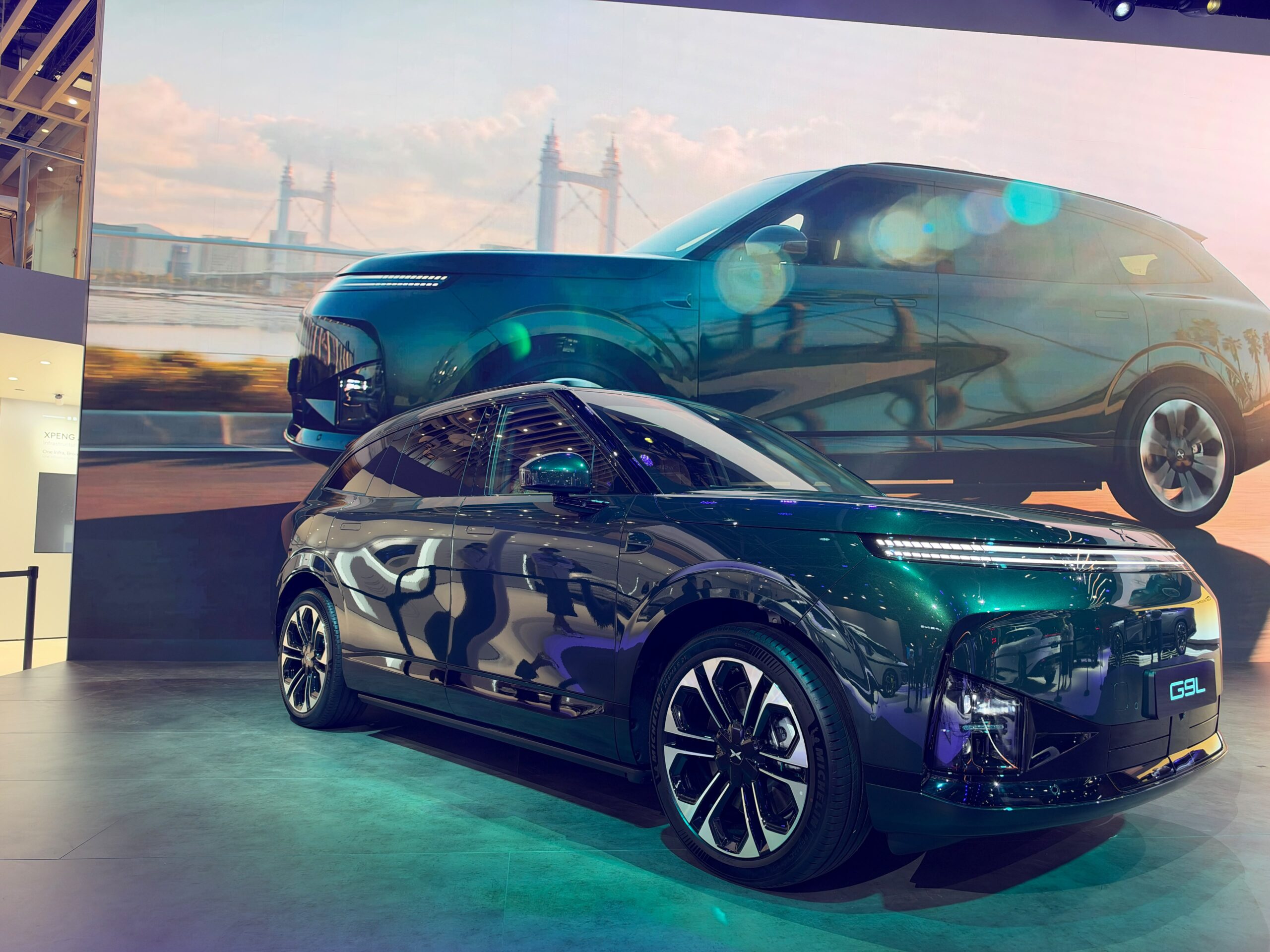
Electric cars are no longer the weird bit of the motor show. The weird bit is that the car company is also building humanoid robots and flying vehicles. Thanks to XPENG, I went to the Paris Motor Show to see what the future of mobility actually looks like. Spoiler: it looks expensive, clever, and increasingly difficult to explain to your dad. We absolutely loved it! There is no doubt, Xpeng are taking travel to a whole new level.
I Went to the Paris Motor Show with XPENG. The Future Has Wheels, Wings and a Slightly Unsettling Robot.
Disclosure: The Sustainable Dad attended the Paris Motor Show with support from XPENG. The opinions, questions and mild existential wobble in this article are my own.
There are two ways to visit a motor show. You can wander around looking at shiny cars and nodding as if you understand torque. Or you can walk into a hall and discover that the car company you came to see is also working on humanoid robots and flying cars, at which point you start wondering whether you’ve accidentally wandered into a very expensive episode of Black Mirror.
I was at the 2026 Paris Motor Show thanks to XPENG, and it turned out to be a rather good place to ask a question that matters to anyone who cares about sustainability: what does the next era of transport look like, and will it make our lives better, cleaner and less ridiculous?
The short answer: electric cars are now the main event, software is becoming as important as the metal, and the competition is getting fierce. The longer answer involves a new flagship SUV, European carmakers rediscovering their nerve, and robots that make you wonder if you should have been nicer to your laptop.
XPENG G9L: the big new launch
The headline at XPENG’s stand was the global launch of the G9L, its next-generation AI flagship SUV. XPENG announced the European launch at the show on 12 October, with French pricing starting at €74,990. The company says the model is intended to become its fourth vehicle produced in Europe, part of a wider push to build and serve the European market rather than simply export cars into it.
The G9L is pitched as a premium, AI-defined SUV, bringing together intelligent driving technology, comfort and a large-car experience. XPENG also highlighted its Next Generation Pilot (NGP) system powered by VLA 2.0, which was being demonstrated to the public in Europe for the first time at scale. XPENG and Tesla were the two carmakers involved in the show’s Autonomous Lab experience.
That matters because the electric-car conversation has moved on. Range and charging still matter, obviously. Nobody wants to plan a family road trip like a military logistics operation. But the next battle is also about the software: how a car understands its surroundings, assists its driver and earns trust without pretending that a complicated system is magic.
A quick reality check, though: ‘AI-powered’ is not a synonym for ‘perfect’, and driver assistance is not permission to stop paying attention. The useful question is not whether a car can do clever things. It is whether those things are safe, transparent, dependable and genuinely helpful in the messy real world.
Cars are only half the story: meet the robots
XPENG’s stand was designed as a kind of Physical AI showcase, with vehicles alongside humanoid robotics and future-mobility technology. Its IRON humanoid robot is part of the company’s ambition to take its AI and engineering beyond the car. XPENG said IRON had come off a newly commissioned production line in September, a step towards mass production.
Humanoid robots are a brilliant way to make a technology stand feel like the future has arrived. They are also a brilliant way to make a grown adult quietly check whether the robot has noticed him checking whether it has noticed him.
The serious point is that the technologies behind robots and smart vehicles can overlap: perception, motion planning, sensors, computing and the ability to act in the physical world. That does not mean a robot will be folding your laundry next Tuesday, although I wish it would! It does mean the boundary between car technology and robotics is becoming less clear.
For sustainability, the test should be practical rather than sci-fi. What tasks can automation do more safely or efficiently? What materials, energy and resources does it consume? Who benefits, and who carries the costs? A robot is not sustainable just because it looks like tomorrow.
Flying cars: because traffic apparently needed a third dimension
XPENG also showcased its flying-car work. The phrase ‘flying car’ still sounds like something a screenwriter invented after running out of ideas, but companies are seriously exploring electric vertical take-off and landing aircraft and other forms of low-altitude mobility.
The caveat is enormous: prototypes and demonstrations are not the same thing as a mass-market transport system. Certification, safety, noise, infrastructure, airspace management, cost and energy use all have to be solved. And if we cannot organise a roundabout without a collective nervous breakdown, managing a sky full of vehicles will take more than a cool launch video.
Could these technologies eventually make sense for specific journeys or specialist uses? Possibly. Will they replace trains, buses, cycling and walking as the sensible answer to everyday urban travel? That is a much harder sell. The sustainable future should not be a competition to put the most expensive thing in the air.
The rest of the Paris Motor Show: a crowded field
XPENG was not the only brand with something to say. This year’s show felt like a snapshot of a European car industry being pushed to move faster, offer more affordable electrification and respond to increasingly capable Chinese competitors.
Citroën brought a modern interpretation of its much-loved 2CV idea into the conversation, with affordability and accessible motoring front and centre. It is a reminder that the electric transition will not be won by luxury SUVs alone. If electric mobility is going to become normal, it has to become attainable.
Stellantis had a broad spread of concepts and launches across its brands, including the Fiat Grizzly, Lancia Gamma and Opel Corsa GSE, while Peugeot showed new concept directions. Dacia’s next-generation Spring and Striker also pointed to the importance of value-led electrification and hybrids. BYD’s large Atto 8 SUV made the point that Chinese brands are competing across more than one price bracket.
Zeekr made its Paris Motor Show debut with its existing range and two new models, adding to the sense that Europe’s showroom choices are expanding quickly. The competitive message was hard to miss: established European manufacturers are not just competing with one another any more. They are competing with brands that have become very good at combining batteries, software, design and speed of development.
The danger is that the industry gets distracted by bigger screens, bigger vehicles and bigger promises. The opportunity is that competition accelerates better batteries, more efficient production, useful software and electric cars that more people can afford.
So, is this sustainable progress?
Here is where I put my Sustainable Dad hat on. A motor show is designed to make you want things. It is a cathedral of polished paint, dramatic lighting and people saying ‘revolutionary’ while standing next to something with four wheels. Don’t get me wrong, that is not automatically a bad thing, but it is not the same as progress.
An electric vehicle can cut tailpipe emissions to zero, but its overall footprint still depends on how the electricity is generated, the battery and materials supply chain, manufacturing, vehicle size and how long the car stays in use. A heavier, more powerful vehicle is not automatically the greener choice just because it plugs in.
The questions I want answered are straightforward: Can the car be built with a lower footprint? Can its battery and components be repaired, reused or recycled? Is the software designed to improve safety rather than merely sell a feature? Is the vehicle efficient in the real world? And can normal families afford it?
XPENG’s approach is interesting because it treats the car as part of a broader technology ecosystem, rather than a standalone lump of metal with a battery. But the sustainability scorecard still has to be earned in production and everyday use, not on a stage in Paris.
The Sustainable Dad verdict
The Paris Motor Show made one thing clear: the future of cars is not just electric. It is electric, connected, software-defined and increasingly tangled up with robotics. XPENG’s G9L launch was the headline at its stand, while the humanoid robot and flying-car projects offered a glimpse of how far the company wants to stretch its technology.
Elsewhere, the big themes were affordability, the return of familiar names in new forms, and a growing challenge from Chinese manufacturers. The winners will not necessarily be the brands with the flashiest concept or the most convincing robot. They will be the ones that turn clever engineering into safe, useful, affordable products with a credible environmental case.
I came away impressed by the ambition. I also came away with the usual dad-like questions: how much does it cost, how long will it last, can you fix it, and does the world genuinely need another way to travel three kilometres?
Because the future is exciting. But the greenest bit of technology is still the bit that solves a real problem without creating three new ones.
We can’t wait to share our time with you in Paris, which will be dropping to our youtube channel soon. So keep your eyes peeled! In the meantime, check out our other videos and let us know your favourite! https://www.youtube.com/@thesustainabledad
Quick answers: Paris Motor Show and XPENG
What did XPENG launch at the 2026 Paris Motor Show?
XPENG launched its G9L Next-Gen AI Flagship SUV in Europe on 12 October 2026. French pricing was announced from €74,990.
What is the XPENG G9L?
The G9L is XPENG’s next-generation flagship AI SUV, combining a premium SUV format with the company’s latest intelligent-driving and vehicle technologies.
Did XPENG show robots at the Paris Motor Show?
Yes. XPENG showcased its Physical AI ecosystem, including its IRON humanoid robot programme.
Did XPENG show flying cars?
XPENG included its flying-car technology in its wider future-mobility showcase. Such projects remain distinct from ordinary, widely available road transport.
What other launches stood out at the 2026 Paris Motor Show?
Highlights reported around the show included Citroën’s modern 2CV direction, several Stellantis-brand concepts and launches, Dacia’s Spring and Striker, BYD’s Atto 8, and Zeekr’s Paris debut with two new models.
Is an electric car automatically sustainable?
No. Tailpipe emissions are eliminated while driving, but the overall footprint also depends on electricity generation, manufacturing, battery materials, vehicle efficiency, durability and end-of-life treatment.