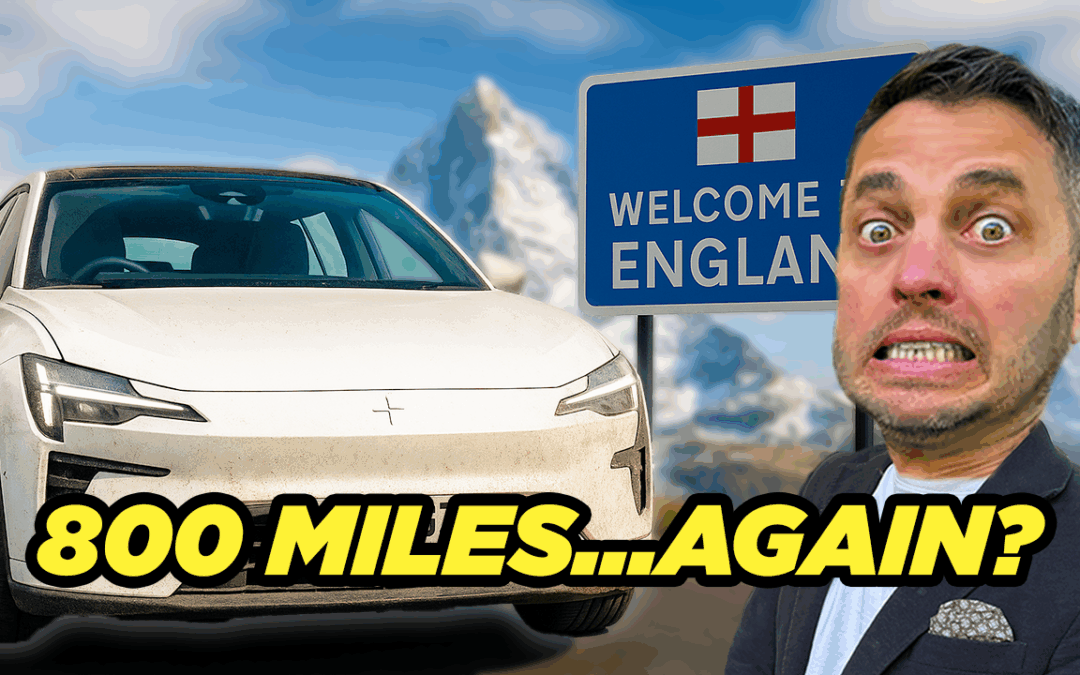
How can the government expect us to ditch diesel if EVs can’t deliver the range they promise?
That’s what I set out to find out on this journey, driving the Polestar 4 over 1,000 kilometres from the Alps back to London in a single day. The mission? Get the kids home in time for school on Monday and avoid a hefty fine from the headteacher. Easy, right?
The Challenge: Alps to London, One Day, One Charge (Hopefully)
It’s 6:00 a.m. The car’s packed, the kids are semi-conscious, and I’ve just entered our route into the Polestar’s navigation:
12 hours and 7 minutes, three charging stops, and 1 hour 44 minutes total charging time.
That’s what the car reckons. But me? I think we can beat it.
We start rolling downhill from the mountains, and here’s the first surprise: after 15 minutes of driving, the battery percentage hasn’t moved. In fact, our range is going up. Regenerative braking is a win.
What Even Is WLTP Anyway?
Before we go any further, let’s talk about that mysterious acronym you see plastered across every EV spec sheet: WLTP.
It stands for Worldwide Harmonized Light Vehicle Test Procedure, a standardised test that simulates real-world driving at different speeds and conditions. It’s designed to give you a fair comparison between vehicles, but not necessarily a perfect prediction of how far you will go on a single charge.
The Polestar 4 claims a WLTP range of 385 miles, and in controlled conditions, testers have come impressively close. But this trip was anything but controlled with cold weather, wet roads, fully loaded car, motorway speeds, and two kids in the back.
Could we still hit that number? Let’s find out.
Cruising (and Snacking) Through France
Two hours in, 80% battery left, and 299 miles showing on the dash. So far, so good. No range anxiety but plenty of snack anxiety.
By 10 a.m., we’d been on the road for four hours. The kids were doing great (and making a complete mess in the back). I spotted a charger, but with 188 miles of range left, I decided to press on.
We had one mission: make our Eurotunnel slot. But as anyone who’s driven through France knows, the tolls have a habit of taking their toll.
So when the sat-nav suggested a slower but shorter scenic route to our next charger, we went for it, and I’m so glad we did. The French countryside opened up in front of us, and suddenly the stress melted away. Sometimes, low battery brings you to the most beautiful places.

Charging Drama (and a Quick Detour)
We rolled up to an Ionity 350kW charger with 8% battery left, only to find our chosen bay wasn’t working. Classic. Thankfully, another EV pulled out just in time and we slotted in. Plugged in, hit “Start,” heard the clunk… and we were charging.
From 6% to 68% in about 30 minutes, just enough time for a toilet break and a leg stretch for the kids. The Polestar’s 200kW max charging rate really shows its worth here.
A Quick Reflection: The Polestar 4 Verdict
After 2,000 km with the Polestar 4, I can honestly say this is one of the best cars I’ve ever driven. Full stop. Electric or petrol. (Did I really just say that?)
It’s quick, quiet, comfortable, and cleverly designed. The lack of a rear window takes getting used to (the camera is sharp, but you do miss glancing over your shoulder sometimes). Still, the trade-off is loads of space in the back, perfect for taller passengers.
And that WLTP figure of 385 miles? We managed 382 miles on a single charge in cold, wet conditions with a fully loaded car. In my book, that’s seriously impressive.
A Few Family Road Trip Tips
If you’re planning a long EV road trip with kids, here’s what I’ve learned:
- Pack light. We brought everything but the kitchen sink. Don’t copy us!
- Check your tyre pressure before you go. It really makes a difference.
- Plan your charging stops, but don’t panic if plans change. Sometimes the detour’s the best bit.
- Snacks > gadgets. Keep the kids fed and morale stays high.
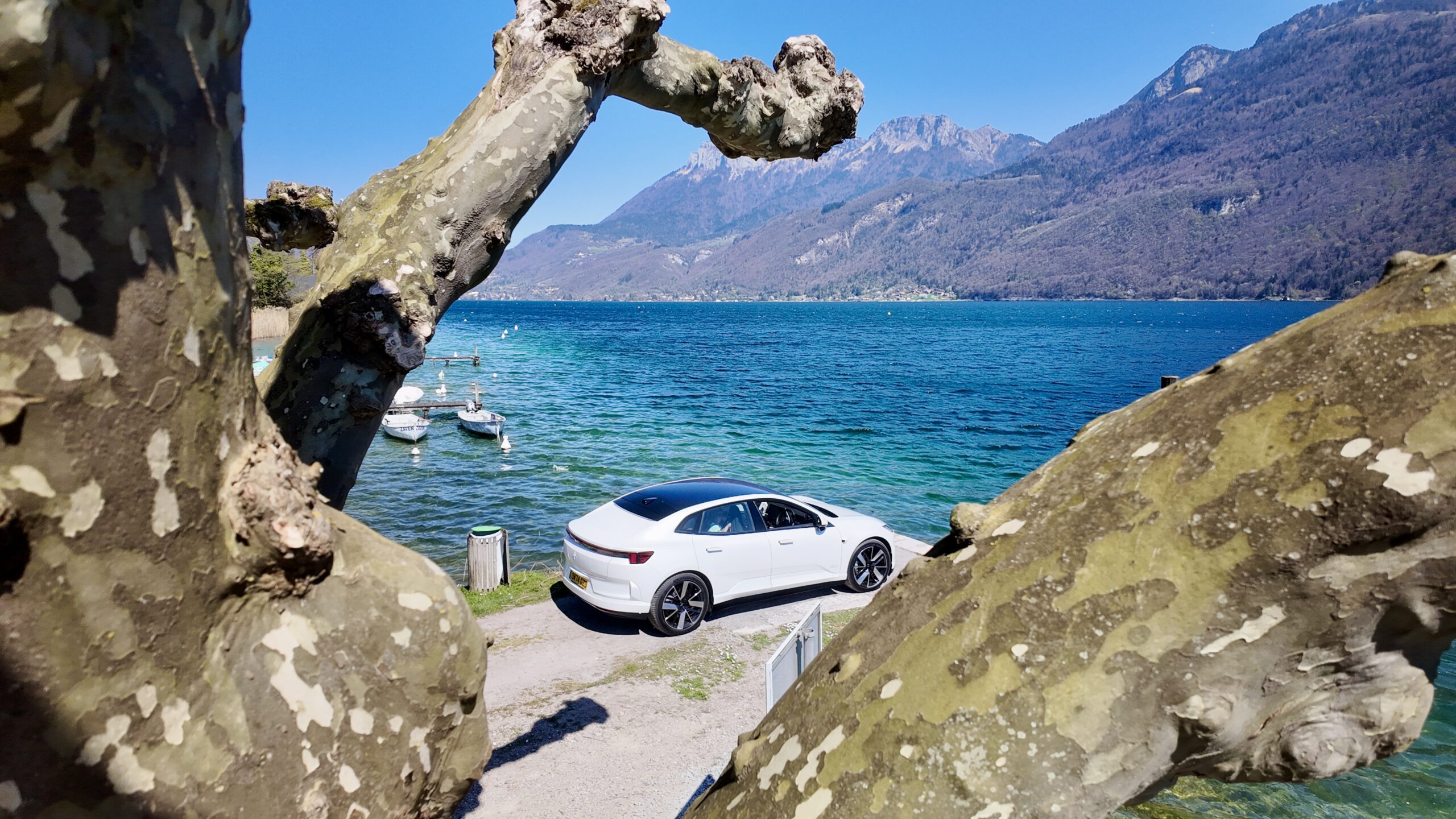
The Final Stretch
We almost made the rookie error of undercharging on our last stop. Arriving five miles short of Calais would’ve been painful. Luckily, a quick top-up at a Total Energies charger saved the day (after three failed attempts to get it working, naturally).
Back in Blighty, we gave the Polestar one last five-minute zap at Gridserve, just enough to get us comfortably home. And yes, we celebrated the end of our 1,000km journey in true British style: with chicken and chips.
Final Thoughts
The Polestar 4 didn’t just meet its range claim; it proved that modern EVs can go the distance, even when loaded with luggage, kids, and real-world conditions.
Sure, there were moments of mild panic and questionable snack choices, but the drive itself was smooth, quiet, and genuinely enjoyable.
If you’re still on the fence about going electric, take it from me: range anxiety fades fast when the car’s this good.